








Creole Cottage
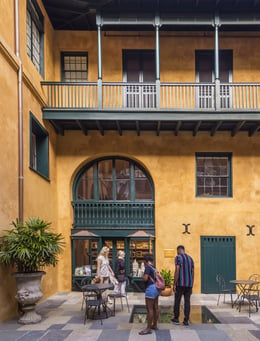
Creole cottage with dependency, built ca. 1835
This is a typical example of one of the French Quarter’s most dominant architectural styles, the Creole cottage. This cottage follows the standard floor plan of four rooms situated around a central chimney. It was used as a rental property, cigar shop, bar, art gallery, and workshop.
Timeline

1806: Marie Françoise Dejan Durel purchases a double lot from Françoise Morgan Coffigny.
1830s: Durel divides the property and builds two Creole cottages, modern-day 726–28 and 732–734 Toulouse.
1846: Louise Hardy de Boisblanc purchases 726–28 Toulouse and rents it out as a duplex. Three years later, she leaves it to her daughter, Adele Hardy de Boisblanc, the fourth consecutive female owner of the property.

1876: Real estate investor Thomy Lafon adds the Creole cottage to his portfolio. Born a free person of color, Lafon had an estimated fortune of $250,000 in 1870, making him the wealthiest Black man in the country.

1893: Lafon dies, leaving his estate to numerous Catholic and Black charities. The profits of this rental cottage are directed to the Society of the Holy Family, an order of Black nuns. Census records show that the four-room rental houses up to 10 people at a time.
1958: John Amos McFarlane, better known as Candy Lee, lives in the rear dependency at 728 ½ Toulouse and works as a bartender at neighboring Tony Bacino’s Bar. Bacino’s is a center of the French Quarter gay community at a time when homosexual activity was illegal, and Candy Lee is arrested for being a person of “lewd character” so many times she eventually takes the police to civil court for a restraining order.

1968: The cottage is no longer used for rental housing but for business. In 1968, Mike Stark bases his “Rent-a-Hippie” Tours out of one side of the cottage. The other side is used as a tobacco-pipe shop, then as a gift shop of Louisiana handiwork.
1989: HNOC purchases the Creole cottage from Thomy Lafon’s estate. An archaeological dig under the house finds evidence of early French colonial military barracks. The cottage is used as a workshop for HNOC’s preparation and maintenance departments.
Our Buildings
HNOC’s Architectural Treasures
Every building has stories to tell. Learn more about HNOC’s historic French Quarter properties.


Related Stories

The Woman behind New Orleans’s Famous Pontalba Buildings
The Baroness de Pontalba survived gunshot wounds and left her husband in France before constructing two of New Orleans's most iconic structures.

Beyond Nottoway
The mansion at Nottoway Plantation burned to the ground, but related sites survive across the South.
Related Collection Highlights

Clarence John Laughlin Archive
Through his dreamlike black-and-white images, the surrealist Louisiana photographer explored, amplified, and commented on the mystique of the South.


Mother St. Croix Photographs of Ursuline Convent
The ebullient nun documented her cloisters, sisters, and pupils with care and skill. In doing so she became the earliest known woman to photographically record daily life in New Orleans
Related presentations
Vieux Carré Survey Case Study

Related Books


Guidebooks to Sin: The Blue Books of Storyville, New Orleans
by Pamela D. Arceneaux
with a foreword by Emily Epstein Landau

Haunter of Ruins: The Photography of Clarence John Laughlin
with essays by Jon Kukla, John H. Lawrence, Andrei Codrescu, Ellen Gilchrist, Shirley Ann Grau, Jonathan Williams, Albert Belisle Davis, and John Wood
Related News

NOLA.com Features HNOC’s Paul Prudhomme Building Among 19 Award-Winning Historic Renovation Projects

HNOC Names Former K-Paul’s Restaurant Building in Honor of Chef Paul Prudhomme

NOLA.com: This Former French Quarter Restaurant Will Now Tell New Orleans History After $6.4M Renovation
Subscribe to Our Newsletter
